
By Dr Neil Taylor
Here is a scenario that has played out in drug discovery teams more times than it should. A structural biologist solves an excellent structure of a target bound to a candidate from the current lead series. The binding mode is analysed, written up and passed to the medicinal chemistry team. Weeks later, the project has moved in a very different direction – largely intuition-driven, with little apparent use of the structural data.
The structural biologist is frustrated. The medicinal chemists feel the structure was less useful than other possibilities they were exploring. Both perspectives may contain some truth.
But this disconnect remains one of the most persistent, and costly, inefficiencies in drug discovery; and it deserves to be named more directly.
Structural biology and medicinal chemistry have developed as distinct scientific disciplines, each with its own training, language and professional instincts.
Structural biologists think in three dimensions. They focus on space groups, unit cell dimensions, asymmetric units, crystal packing, ligand atom resolution, bound waters, partial occupancy, binding regions and conformational flexibility. Medicinal chemists think in synthesis routes, starting materials, ADMET properties, SAR trends, bio-isosteres, matched molecular pairs and the hard-won intuition that helps define what makes a molecule viable.
Both perspectives are essential. Yet in many organisations, these disciplines still work in sequence rather than in genuine dialogue. Structural data is handed over like a report. Design hypotheses move in one direction. The iterative back-and-forth that turns the analysis of protein structure into practical design decisions is either weak or missing altogether.
Too often, target protein structural data is treated as a single supporting data point, a way to explain unexpectedly high or low affinity after the fact, when its real value should be much greater. In the best environments, structural insight helps shape decisions early, guides compound design more intelligently and improves the quality of discussion across the whole discovery team.
The cost of poor collaboration is not abstract. It affects the speed, quality and efficiency of drug discovery.
When medicinal chemists do not engage deeply with structural biology, promising design vectors can be missed. Selectivity opportunities hidden in subtle structural differences may go unexplored. Binding site insights that could sharpen a structure-based drug design strategy may never be fully used.
At the same time, when structural biologists do not understand the synthetic, practical and physicochemical constraints their medicinal chemistry colleagues are managing, they risk generating hypotheses that are scientifically elegant but difficult, inefficient or impossible to build in practice.
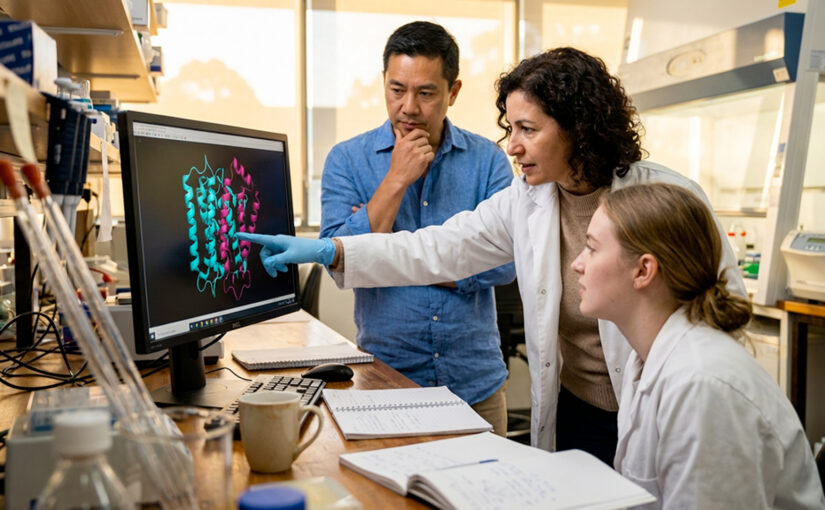
The most effective drug discovery programmes do not separate these perspectives. They bring them together repeatedly. The best work happens when structural biologists are in design meetings, supported by modelling expertise, rather than simply sending slide decks. It happens when medicinal chemists actively question sidechain flexibility, conserved water molecules and conformational behaviour, rather than accepting a static binding mode at face value.
That kind of exchange does more than improve communication. It improves decision-making.
Part of the answer is cultural, but part of it is technical.
Modern structural data platforms are making it easier for structural biologists and medicinal chemists to work from a shared view of the problem. When structural data can be explored in context, alongside SAR trends, selectivity data and real compound information, collaboration becomes more natural and more productive.
It gives chemists better access to structural insight and gives structural biologists better visibility into the practical demands of medicinal chemistry.
Dr. Neil Taylor, Founder, DesertSci
This kind of structural informatics helps create a shared language across disciplines. It gives chemists better access to structural insight and gives structural biologists better visibility into the practical demands of medicinal chemistry. In real meeting environments, that can make a meaningful difference to how quickly teams evaluate hypotheses, challenge assumptions and move from insight to action.
This is one of the goals of DesertSci’s Proasis platform. Interdisciplinary collaboration has always been central to how Proasis is designed and to the role it plays in structure-based drug design, computational chemistry and modern drug discovery workflows.
But technology is only an enabler. It cannot replace genuine interdisciplinary thinking.
The organisations doing this well are deliberate about it. They structure teams to encourage collaboration, co-locate disciplines where possible, create shared ownership of programmes and recognise the value of integrative thinking that no single function can produce alone.
As AI in drug discovery becomes more capable, the need for close collaboration between disciplines only increases.
AI-driven structure prediction and generative design tools can help filter hit lists faster and surface more hypotheses more quickly. But that does not remove the need for scientific judgement. If anything, it increases it. The bottleneck is shifting toward human interpretation, the ability to assess, prioritise and act on structural insight with the combined strength of chemical understanding and biological context.
This is where collaboration becomes a competitive advantage. Drug discovery machine learning can generate options, but experienced scientists still need to decide which ideas are useful, which are realistic and which deserve to move forward.
That is why the future of SBDD is not structural biologists and medicinal chemists working in parallel. It is both disciplines thinking together, challenging each other constructively and operating within workflows that make collaboration the default rather than the exception.
The opportunity is not simply to improve communication between teams. It is to build better organisations, better workflows and better scientific infrastructure around a truth the industry already knows: structural biology and medicinal chemistry are at their strongest when they are closely connected.
When that connection is real, structural data becomes more actionable. Chemistry becomes more informed. Design cycles become more efficient. And the chances of finding better candidates improve.

For more insights into AI in drug discovery, computational chemistry and research-grade scientific software, follow follow Dr Neil Taylor on LinkedIn. Or, if you’d like to arrange a demonstration of DesertSci’s Proasis, please get in touch with our team.