
By Dr. Neil Taylor
Desert Scientific Software was proud to exhibit at the 33rd Protein Structure Determination in Industry (PSDI) meeting in Basel, Switzerland last month. Jointly organised by Andreas Kuglstatter (Roche) and Christian Wiesmann (Novartis), this year’s meeting focussed on two defining forces reshaping the field: the expanding roles of Cryo-Electron Microscopy (Cryo-EM) and AI-driven structural biology, alongside the growing contribution of structural methods to biologics R&D.
Over three days, industry leaders, technology innovators and structural biology teams from across pharma research gathered to share insights, compare emerging technologies and discuss how structural data is accelerating drug discovery.
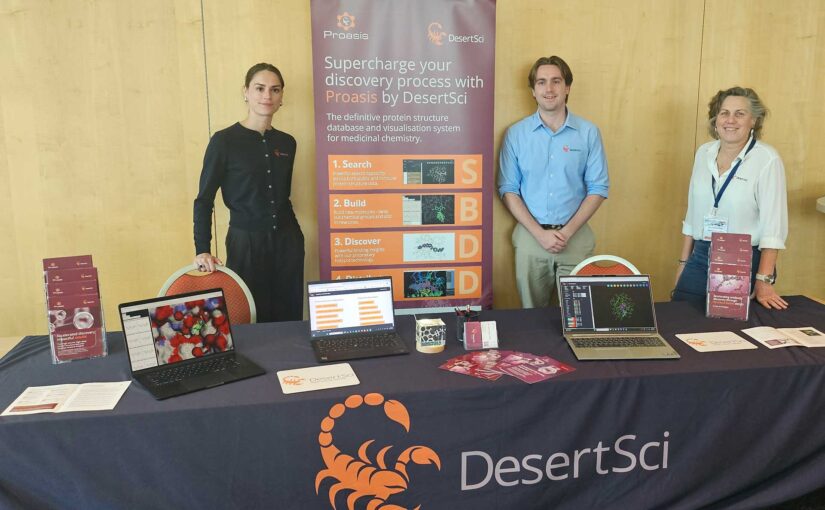
Our booth provided a valuable opportunity to demonstrate Proasis, our structural biology software, to researchers working at the forefront of protein structure determination. The conference also offered a welcome chance to deliver a company talk highlighting how our tools support the efficient delivery of high-value protein structure data and help streamline workflows in an era where methodologies continue to evolve rapidly.
The face-to-face conversations during breaks – something virtual meetings rarely replicate – enabled deeper technical discussion around structural data workflows, automation and challenges shared across the community.
A consistent theme emerged throughout PSDI 2025: structural biology is undergoing simultaneous revolutions driven by Cryo-EM, AI and workflow automation. Developments in these areas are rapidly increasing the diversity and volume of protein structure data being produced, and reducing the time required to move from target identification to structural insight and, ultimately, to design breakthroughs.
Presentations also highlighted the expanding role of structural biology across drug discovery programs involving biologics, where complex assemblies and heterogeneous targets demand more advanced data and analysis capabilities.
Cryo-EM continues its remarkable advance, providing structural information for targets that historically challenged X-ray crystallography, including membrane-bound assemblies such as GPCRs and antibody complexes. The pace of progress is being driven by multiple factors:
Yet perhaps the most striking reminder from PSDI was that X-ray crystallography remains the workhorse of structural biology. It continues to deliver results at roughly 10% of the time and cost of EM, and innovations in high-throughput crystal handling and micro-scale sample preparation are unlocking further productivity gains. This reinforces the importance of maintaining diverse methodological capabilities within structural biology organisations.
AI played a central role in the conference agenda. Across multiple talks, AI was shown to shorten the path from raw data to interpretable structures, fundamentally accelerating the structure determination process.
A standout presentation came from Tobias Plötz, demonstrating Merck KGaA’s approach to democratising AI, enabling all in-house scientists to access advanced AI capabilities rather than restricting them to specialist groups. This kind of organisational commitment illustrates how large pharma is embracing AI not as an add-on, but as core scientific infrastructure.
Automated workflows powered by AI are now compressing timelines that once spanned months into mere days, allowing structural insights to shape project decisions far earlier in the discovery process.
Several talks from structural biology groups at Roche, Sanofi and other major organisations emphasised how central structural data has become, especially in target validation and across a broad spectrum of therapeutic modalities. While much of this work remains confidential, the case studies and strategic frameworks shared at PSDI were highly informative.
We also observed a rapid expansion of specialised contract research organisations (CROs) in structural biology. New entrants are focusing on:
This growing ecosystem reflects the increasing demand for structural biology services and the opportunities created by new technologies.
Noteworthy innovations
Several technologies and initiatives stood out as particularly influential:
Structural biology’s contribution to antibody discovery also continues to expand, enabling deeper analysis of complex biologics and broadening therapeutic opportunities.
One of the most striking aspects of PSDI 2025 was the openness of discussion. Attendees were generous in sharing practical experience and candid views, creating a rare environment for genuine technical exchange. For a field where confidentiality often limits conversation, this degree of transparency was particularly valuable.
For Desert Scientific, PSDI reinforced our commitment to developing structural biology software that keeps pace with this rapidly evolving landscape. We are already looking forward to PSDI 2026 in Sweden, where continued breakthroughs at the intersection of structural biology, AI and drug discovery are anticipated.